

Fergana Valley crafts route: Kokand, Rishtan, Margilan and Chust
A route through the craft heart of Uzbekistan: khan-era Kokand, the turquoise ceramics of Rishtan, hand-woven atlas silk in Margilan and the knife-makers of Chust — with bazaars, workshops and practical tips.
Information last updated on 17.11.2026.
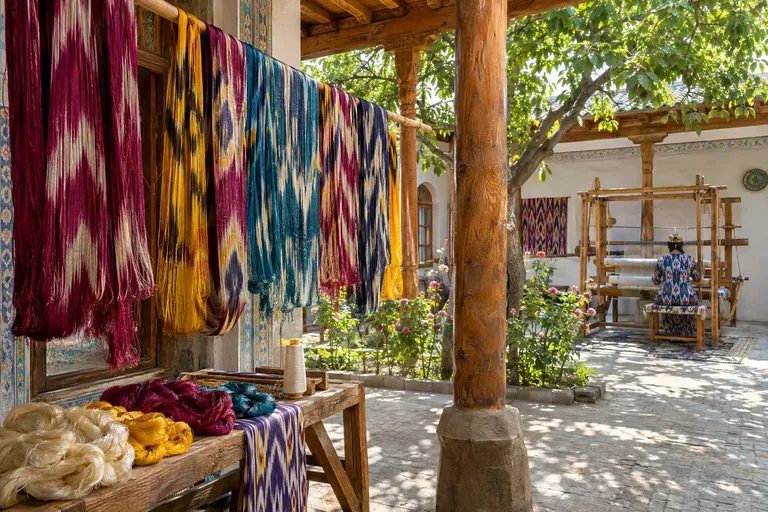
The Fergana Valley is Uzbekistan's most densely populated and most fertile region — a broad basin ringed by the Tien Shan and Pamir-Alay ranges, full of orchards, mulberry trees and cotton fields. It has fewer grand monuments than Samarkand or Bukhara, but it is where many of the country's crafts are still practised in family workshops: silk weaving, ceramics, knife-making and embroidery. A trip here is less about sightseeing and more about watching skilled people at work and meeting the valley's famously hospitable residents.
Kokand: the city of the khans
Kokand was the capital of the Kokand Khanate in the 18th and 19th centuries, and the valley's best-preserved royal buildings are here. The Khudoyar Khan Palace, built in the late 1860s and early 1870s, once had seven courtyards and more than a hundred rooms; several courtyards and 19 rooms survive, with a façade of yellow, green and blue tiles that is one of the most photographed sights in the valley. Inside, a museum displays carved doors, painted ceilings and objects from the khan's era. The Juma Mosque on Chorsu Square, completed in 1819–1822, has a veranda resting on 98 carved wooden columns and a 22.5-metre minaret. Nearby, the Narbuta-bey Madrasah (1799), the largest in the city, stands beside the dynastic tombs of Dakhmai Shakhon and the Modari Khan Mausoleum, both from 1825. End with lunch at a local teahouse, where plov, soups and bread are served on raised platforms.
Rishtan: turquoise ceramics
For centuries Rishtan has made pottery from its local red clay, finished with ishkor, an alkaline glaze made from plant ash that gives the characteristic turquoise and cobalt blue. Several family workshops welcome visitors: you can watch bowls and plates being thrown on the wheel, painted with pomegranates and floral motifs and fired, and buy directly from the makers. A hands-on master class lets you shape and paint your own piece — firing takes several days, so agree with the master how to collect or ship it. Arrange visits in advance and ask for careful packing if you are flying home with ceramics.
Margilan: the silk city
Margilan is the centre of Uzbek silk. At the Yodgorlik silk factory, founded in 1972, the entire process is still done by hand: cocoons are boiled and reeled, threads are tied and dyed in the abrbandi (ikat) technique, and the shimmering khan-atlas and adras fabrics are woven on hand looms. Come in the morning when the looms are running; several sources say it is closed on Sundays. In the town centre, the late-19th-century Said Ahmad Khoja Madrasah houses a crafts centre whose programme for safeguarding atlas and adras techniques was added to UNESCO's Register of Good Safeguarding Practices in 2017. Artisans weave, dye and embroider in the former student cells, and you can buy straight from them.
If your visit falls on a Thursday or Sunday, go early to Kumtepa Bazaar, about 5 km west of the centre, ideally between 8 and 10 am. Rows of atlas and adras fabric, skullcaps, clothing and street food make it one of the best places to see everyday valley life. Bring cash, bargain politely and ask before photographing people.
Fergana city
The regional capital, Fergana, is a green, relaxed city laid out in the late 19th century. The regional museum, one of the oldest in Uzbekistan, gives a good overview of the valley's archaeology, costume and crafts (sources say it is closed on Mondays). The central bazaar is the place for the valley's famous fruit — apricots, cherries, pomegranates and grapes in season — hot bread and dried fruit. Fergana makes a convenient base for Margilan, which is a short drive away.
Chust and Namangan: knives and skullcaps
North of the Syr Darya, the town of Chust has long been known for its blacksmiths. The Chust knife (pichoq) has a characteristic curved blade and a handle of bone, horn or coloured inlay. Around the farmers' bazaar you can watch blades being heated, hammered and sharpened, and buy directly from the maker; beware of cheap factory imitations. Chust is also famous for its black-and-white skullcaps. Remember that knives must go in checked luggage. In nearby Namangan, the Mullah Kyrgyz Madrasah of 1910 has a striking portal of patterned brick and tiles, and the city's flower festival usually takes place in late May or early June.
Andijan: Babur's birthplace
At the eastern end of the valley, Andijan is where Zahiriddin Muhammad Babur, founder of the Mughal dynasty in India, was born in 1483. A house museum in the old town tells his story, and the late-19th-century Jome complex nearby, with its madrasah and minaret, houses a museum of literature and art beside a large bazaar.
How to plan the route
Getting there
From Tashkent the road crosses the Kamchik pass; Kokand is roughly four hours away by car. Passenger trains also run into the valley through the Kamchik tunnel, and there are domestic flights from Tashkent to Fergana, Namangan and Andijan. In winter the pass can be affected by snow, so check conditions.
Sample three-day plan
- Day 1: Kokand's palace, Juma Mosque and royal tombs; afternoon in a Rishtan pottery workshop; night in Fergana.
- Day 2: Margilan — the silk factory in the morning, the Said Ahmad Khoja crafts centre after lunch, Kumtepa Bazaar if it is Thursday or Sunday.
- Day 3: Chust knife-makers and Namangan, or Andijan for Babur's museum; return to Tashkent.
Practical tips
- Workshops are family businesses: call ahead or go with a local guide, and expect to be offered tea.
- Bring cash — most artisans and bazaars do not accept cards.
- Silk prices depend on whether the fabric is pure silk (atlas) or silk-cotton (adras); ask the weaver to explain the difference.
- The valley is conservative by Uzbek standards; dress modestly, especially in mosques and bazaars.
- Spring and autumn are the most pleasant; summer is hot, though shady workshops and teahouses help.
Places in this guide
- Babur House Museum, AndijanMuseum devoted to the life and literary legacy of Zahiriddin Muhammad Babur.
- Andijan Jome ComplexLarge late-19th-century ensemble of a madrasah, minaret and khanaka.
- Chust Bazaar and Knife-Makers' RowMarket where you can buy the famous Chust knives and skullcaps from the makers.
- Fergana Central BazaarBusy farmers' market in the city centre, full of fruit, bread and spices.
- Fergana Regional MuseumOne of Uzbekistan's oldest museums, covering valley history and applied arts.
- Dakhmai ShakhonFamily necropolis of the Kokand khans, founded in 1825 under Umar Khan.
- Kokand Juma MosqueFriday mosque built under Umar Khan, famous for its veranda of 98 carved wooden columns.
- Khudoyar Khan PalacePalace of the last ruler of the Kokand Khanate, now the city's local history museum.
- Modari Khan MausoleumTurquoise-domed tomb built in 1825 for the mother of Umar Khan.
- Narbuta-bey MadrasahKokand's largest madrasah, completed in 1799.
- Shinam Teahouse, KokandSimple daytime local teahouse in Kokand.
- Kumtepa BazaarTraditional valley market near Margilan, busiest on Thursdays and Sundays.
- Said Ahmad Khoja MadrasahLate-19th-century madrasah now filled with artisans' workshops.
- Yodgorlik Silk FactoryMargilan workshop where khan-atlas and adras silks are still made by hand.
- Mullah Kyrgyz MadrasahBuilt in 1910, Namangan's most striking historic building.
- Rustam Usmanov Ceramics Workshop, RishtanFamily workshop and showroom of Rishtan's turquoise and cobalt ishkor-glazed pottery.