

Karakalpakstan: the Aral Sea, the Savitsky Museum and the desert fortresses
Uzbekistan's far west is about more than ruins: a world-class collection of banned Soviet avant-garde art in Nukus, the stranded ships of Muynak, the vanishing Aral Sea and two-thousand-year-old fortresses in the Kyzylkum.
Information last updated on 17.11.2026.
West and north of Khiva the irrigated oasis gives way to desert, and you enter Karakalpakstan, an autonomous republic within Uzbekistan and home of the Karakalpaks, a Turkic people with their own language, yurt traditions and jewellery. Few travellers come this far, and that is part of the appeal. In a few days you can see one of the most remarkable art museums in Central Asia, the ruins of ancient Khorezm, and the starkest reminder anywhere of what happens when a sea is drained.
Nukus and the Savitsky Museum
The regional capital, Nukus, is a quiet Soviet-built city, but it holds a treasure. The Savitsky State Museum of Arts was founded in 1966 by the artist and collector Igor Savitsky, who gathered — often at great personal risk — paintings by Russian avant-garde artists whose work was banned under Stalin. Far from Moscow, he saved thousands of canvases that would otherwise have been destroyed, and the museum now holds one of the largest collections of its kind in the world, alongside works by artists who painted in Uzbekistan in the 1920s–1930s. Further sections cover the archaeology of ancient Khorezm and Karakalpak folk art: jewellery, carpets and yurt decorations.
- Open Tuesday to Sunday, 09:00–18:00; closed on Mondays.
- Ticket for foreign adults approximately 100,000 som; large bags go to the cloakroom.
- Allow at least two to three hours. A guided visit in English or Russian brings out the story behind the collection.
Around Nukus
Mizdakhan, west of the city near Khojeyli, is an ancient town and necropolis where the ruins of the Gyaur-Kala fortress stand among mausoleums of many periods, including the semi-underground Mazlumkhan Sulu mausoleum. It is still an active cemetery and pilgrimage site, so behave respectfully. South-east of Nukus, the hilltop Chilpik is interpreted as a Zoroastrian "tower of silence", where the dead were once exposed to birds. A steep, loose path leads up to wide views over the Amu Darya; wear closed shoes. Chilpik lies by the road towards Ayaz-Kala, so it is an easy stop on the way south.
Muynak and the Aral Sea
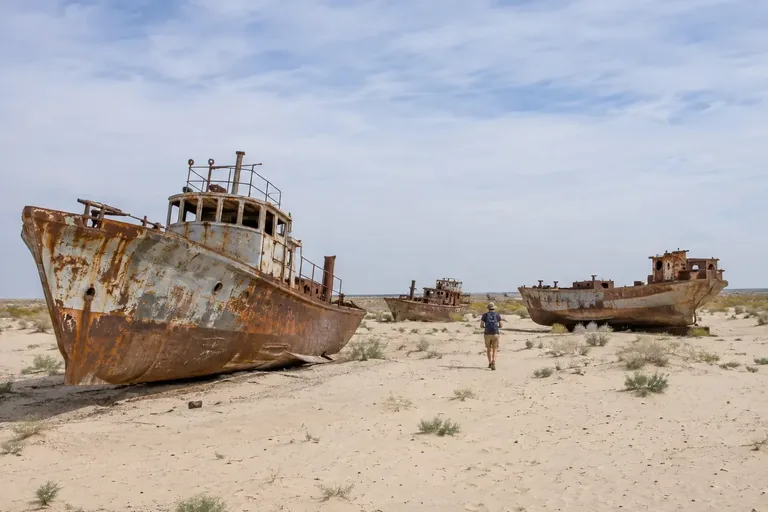
Until the 1960s the Aral Sea was one of the largest lakes on Earth, and Muynak was a busy fishing port with a cannery. Then the waters of the Amu Darya and Syr Darya were diverted on a massive scale to irrigate cotton fields; the sea shrank, split into separate basins and retreated far from the town. Today a group of rusting fishing boats lies on the sand below a memorial on the old shoreline — the ship cemetery — and the view out over what used to be sea is hard to forget. Access is free; take care if climbing on the hulls, which have sharp edges.
Visit the Muynak Museum of Regional Studies first: photographs of the port in its heyday, records of the cannery and paintings on the Aral theme, together with maps of the receding shoreline, put the landscape into context.
Reaching today's shoreline
The present shore of the Aral lies several hours from Muynak by 4x4, across the dried seabed and onto the Ustyurt plateau, with its steep escarpments (chinks) and empty horizons. Yurt camps near the shore let you stay overnight for sunset and sunrise. The water is very salty and the shallows are muddy. This is not a trip to attempt independently: there is no mobile signal, tracks are unmarked and conditions change with the weather. Go with an experienced driver, ideally on a two- or three-day tour from Nukus, and travel in spring or autumn, when temperatures are bearable.
The fortresses of ancient Khorezm
Between Nukus and Khiva, in the Ellikkala district on the edge of the Kyzylkum, stand the mud-brick fortresses of ancient Khorezm — the area is often called the land of the "fifty fortresses".
- Ayaz-Kala is a group of three fortresses; the highest, Ayaz-Kala 1, is believed to have been built as a frontier fort centuries before the Common Era, and its walls and towers are remarkably well preserved. The climb takes 15–20 minutes. At the foot of the hill a yurt camp offers dinner, breakfast and short camel rides, usually from April to October; it is about two to two and a half hours by car from Khiva.
- Toprak-Kala, about 30 km south-west of Ayaz-Kala, was a residence of Khorezm's rulers in the first centuries AD; excavations uncovered wall paintings, sculpture and documents in its three-towered palace.
- Kyzyl-Kala, a small square fort a few kilometres away, has been partly restored, which makes it easy to imagine how these strongholds looked.
How to plan the trip
Getting there
Nukus has an airport with flights from Tashkent and is also reached by train. From Khiva or Urgench it is roughly three hours by road. The most convenient pattern for most travellers is to combine Karakalpakstan with Khiva: a day trip to the fortresses, or an overnight at Ayaz-Kala, then continue to Nukus and Muynak.
Sample plan
- Day 1: from Khiva to Ayaz-Kala, Toprak-Kala and Kyzyl-Kala; sunset and a night in the yurt camp.
- Day 2: via Chilpik to Nukus; afternoon at the Savitsky Museum.
- Day 3: Mizdakhan, then north to Muynak's museum and ship cemetery; return to Nukus or continue by 4x4 to the Aral shore for a night in a yurt camp.
Season and practicalities
- Spring (April–May) and autumn (September–October) are best. Summer is extremely hot and winter bitterly cold, with strong winds.
- Bring cash: card acceptance is limited outside Nukus hotels.
- Carry plenty of water, sun protection and a warm layer for desert nights.
- Distances are long and public transport is sparse — hire a car with driver or join a tour.
- Keep your passport with you; hotels and camps handle registration.
Karakalpakstan asks for more effort than the classic cities, but it rewards it with something rare: art that survived against the odds, history on an epic scale and a landscape that tells a story every visitor should hear.
Places in this guide
- Aral Sea Shore (Ustyurt)The present-day Aral Sea shore below the Ustyurt cliffs, reached by well over a hundred kilometres of off-roa…
- Ayaz-KalaA complex of ancient Khorezmian fortresses on hills at the edge of the Kyzylkum — the best known of the "fift…
- Ayaz-Kala Yurt CampA yurt camp at the foot of the Ayaz-Kala hill — a desert night, camel rides and a Karakalpak dinner.
- Chilpik DakhmaAn ancient Zoroastrian "tower of silence" crowning a hill above the Amu Darya.
- Kyzyl-KalaA compact ancient Khorezmian fort near Toprak-Kala with partly restored walls.
- Mizdakhan NecropolisRuins of an ancient town and a vast cemetery in use for centuries near Khojeyli — an important pilgrimage sit…
- Muynak Regional MuseumA small museum on the Aral Sea and Muynak's fishing past.
- Muynak Ship CemeteryRusting fishing boats on the dried-up former shore of the Aral Sea — a memorial to an ecological disaster.
- Savitsky State Museum of ArtsThe "Louvre of the Desert" — a world-famous collection of Russian avant-garde and Karakalpak applied art.
- Toprak-KalaRuins of a palace-fortress of the ancient Khorezmian rulers — one of the key archaeological sites of the Elli…