

Khiva in 1 day: a walk through the walled city of Itchan Kala
How to see Khiva's inner town in one unhurried day: Kalta Minor in morning light, the Kunya Ark, the forest of columns in the Juma Mosque, Khorezmian food for lunch and sunset from the city walls.
Information last updated on 17.11.2026.
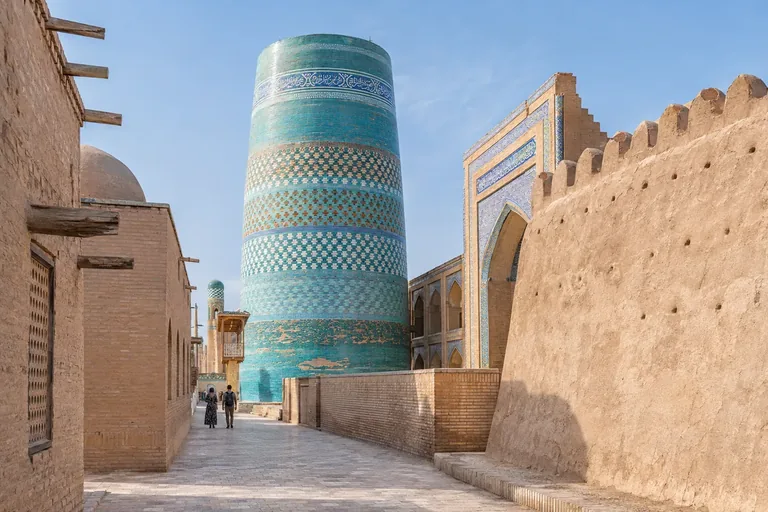
Khiva is the most complete walled city on the Silk Road. Its inner town, Itchan Kala, is enclosed by massive mud-brick walls and was the first site in Uzbekistan to be inscribed on the UNESCO World Heritage List, in 1990. Most of what you see — madrasahs, minarets, palaces and houses where people still live — dates from the 18th to the early 20th century, when Khiva was the capital of a khanate. The whole inner town measures only a few hundred metres across, so a single well-planned day lets you see it properly, including the moment that makes Khiva unforgettable: sunset from the walls.
Before you start
- Getting here: fly to Urgench (about 30–40 minutes by taxi from Khiva), take the train from Bukhara (about 6–7 hours), or, since May 2026, the high-speed Jaloliddin Manguberdi service from Tashkent via Samarkand and Bukhara (about 7.5 hours; check how often it runs). Staying inside or just outside the walls is the best way to enjoy the town early and late.
- Ticket: the combined Itchan Kala ticket, sold at the office by the western Ota Darvoza gate, costs approximately 250,000 som for foreign adults and covers most museums. Keep it with you — it is checked at each building. Climbing the Islam Khoja minaret and the Ak Sheikh Bobo bastion costs extra.
- Heat: in summer Khiva regularly passes 40°C. Plan outdoor walking for the morning and evening and spend midday in the shaded halls of the palaces.
- Dress: the Pahlavon Mahmud Mausoleum is an active shrine; cover shoulders and knees, and women should cover their hair.
Morning: Kalta Minor, the Ark and the patron saint
Enter through the West Gate at about 08:00. The first thing you see is Kalta Minor, the "short minaret", wrapped entirely in turquoise, green and white glazed tiles. Muhammad Amin Khan began it in the 1850s intending to build one of the tallest minarets in the region, but work stopped when he was killed in 1855, leaving a stout trunk about 29 metres high. Morning sun lights its eastern side. Next to it is the khan's madrasah, the largest in Khiva, now a hotel, whose façade you can admire from the street.
Opposite stands the Kunya Ark, the citadel of the Khivan khans, built from the late 17th century. Inside are the reception hall (kurinishkhana), a summer mosque, the mint and harem quarters; the walls of the reception hall and mosque are covered with superb blue-and-white majolica. Note the Ak Sheikh Bobo bastion — you will come back to it at sunset.
Walk south to the Pahlavon Mahmud Mausoleum. The 14th-century poet, wrestler and furrier is revered as Khiva's patron saint, and the mausoleum, rebuilt in the 19th century, carries the largest turquoise dome in the city. Its inner chambers are dense with tilework and members of the royal family are buried here. Pilgrims drink water from the well in the courtyard, which is believed to be healing.
Late morning: Islam Khoja and the Juma Mosque
The Islam Khoja ensemble, built in 1908–1910 by a reforming grand vizier, has the tallest minaret in Khiva, at more than 56 metres. A narrow, steep and dark staircase leads to the top for a panorama of the whole of Itchan Kala; the climb is paid separately and is not suitable for small children. The small madrasah holds a museum of applied arts with wood carving, ceramics and metalwork.
Time your visit to the Juma Mosque for around midday. It has no portal and no dome: a flat roof rests on more than two hundred carved elm columns, a few of them thought to date from the 10th–11th centuries. At noon light falls straight down through two openings in the roof, and the forest of columns becomes one of the most atmospheric interiors in Central Asia.
Lunch: Khorezmian cuisine
Khorezm has its own cooking, quite different from the rest of Uzbekistan. Try shivit oshi — bright green dill-infused noodles served with a meat-and-vegetable stew and yoghurt — and tukhum barak, delicate dumplings filled with egg. Eating in the historic student cells of the Allakuli Khan Madrasah is an experience in itself; expect a bill of approximately 130,000 som.
Afternoon: palaces and the eastern gate
Spend the hot hours in Tash Hauli, the "stone courtyard" palace built for Allakuli Khan in the 1830s. Its harem courtyard, with separate iwans for the khan and his four official wives, tall carved wooden columns and blue-and-white majolica, ranks among the finest examples of Khorezmian architecture. Then step outside towards the eastern Palvan Darvoza gate, where the Allakuli Khan Madrasah, a caravanserai and a domed trading arcade (Tim) form the liveliest corner of the old town. Craftsmen sell carved wood, suzani and fur hats — this is the place to watch woodcarvers at work or join a short workshop.
A few minutes' walk outside the walls, in the outer town of Dishan Kala, the Nurullaboy Palace shows the last years of the khanate: early 20th-century halls where Khorezmian carving meets European stoves and chandeliers.
Evening: sunset from the walls
Return to Kalta Minor for tea on a terrace, then head to the Kunya Ark about an hour before sunset. From the Ak Sheikh Bobo bastion, or from the open section of the city wall, you watch the minarets and domes of Itchan Kala turn gold and then pink. You can go on your own or join a short guided sunset walk. Finish with dinner on a rooftop terrace overlooking the illuminated minaret — book a day or two in advance in high season.
If you have more time
- Take a Khorezmian cooking class to learn shivit oshi and tukhum barak.
- Drive about two to two and a half hours into Karakalpakstan to the desert fortresses of Ayaz-Kala and Toprak-Kala, with a night in a yurt camp.
- Simply wander the residential lanes in the early morning, when Itchan Kala belongs to its inhabitants.
Itinerary
Itchan Kala
Buy the combined ticket at the office by the West Gate (Ota Darvoza) — approximately 250,000 som. Keep it with you: it is checked at each museum; climbing minarets and bastions is extra.
- 2 min walk
Kalta Minor
In the morning the sun lights the minaret's eastern side — the best time for photos. Admire the façade of the Muhammad Amin Khan Madrasah next to it.
- 1 min walk
Kunya Ark
The khan's reception hall (kurinishkhana) and the blue-and-white majolica of the summer mosque. You will return to the Ak Sheikh Bobo bastion at sunset.
- 3 min walk
Pahlavon Mahmud Mausoleum
Tomb of the wrestler-poet regarded as Khiva's patron saint, under the largest turquoise dome in town. An active shrine: women cover their hair, everyone covers shoulders and knees.
- 1 min walk
Islam Khoja Minaret and Madrasah
At over 56 metres the minaret is Khiva's tallest structure; the climb is paid separately and the stairs are steep and dark. The madrasah houses an applied-arts museum.
- 1 min walk
Khiva Juma Mosque
More than two hundred carved elm columns. At midday light falls straight through the roof openings into the hall.
- 2 min walk
Khorezm Art Restaurant
Lunch in the cells of the Allakuli Khan Madrasah: shivit oshi, tukhum barak and pumpkin manti. Average bill approximately 130,000 som.
- 1 min walk
Tash Hauli Palace
Allakuli Khan's palace: the harem courtyard, tall iwans and blue-and-white tiles. The shaded iwans are pleasant in the hottest hours.
- 1 min walk
Allakuli Khan Madrasah
The madrasah, caravanserai and domed Tim by the eastern Palvan Gate — the liveliest trading corner of Itchan Kala; browse the crafts.
- 10 min walk
Nurullaboy Palace
An early-20th-century palace in Dishan Kala: Khorezmian carving alongside European stoves and chandeliers. A few minutes' walk from Itchan Kala.
- 7 min walk
Bir Gumbaz Tea House
Rest on the terrace facing Kalta Minor with tea or cardamom coffee.
- On foot
Khiva Sunset from the Walls
Meet at the West Gate about an hour before sunset and watch the minarets turn golden from the Ak Sheikh Bobo bastion. The start time shifts with the season.
- On foot
Terrassa Cafe & Restaurant
Dinner on a rooftop terrace overlooking Kalta Minor; vegetarian options available. Average bill approximately 150,000 som; reserve a table a day or two ahead.
Route map
Places in this guide
- Itchan KalaKhiva's walled inner city, an open-air museum and Uzbekistan's first UNESCO World Heritage Site (1990).
- Allakuli Khan MadrasahA 19th-century madrasah by the East Gate, next to the caravanserai and the domed Tim trading arcade.
- Bir Gumbaz Tea HouseA teahouse terrace facing Kalta Minor — a handy stop for tea and light dishes.
- Islam Khoja Minaret and MadrasahKhiva's tallest minaret and its small madrasah, the last major ensemble built in the early 20th century.
- Khiva Juma MosqueA unique domeless Friday mosque whose roof rests on more than two hundred carved wooden columns.
- Kalta MinorThe squat, unfinished minaret clad entirely in turquoise glazed tiles — Khiva's most recognisable landmark.
- Khorezm Art RestaurantA restaurant in the cells of the Allakuli Khan Madrasah specialising in Khorezmian national dishes.
- Kunya ArkThe citadel of the Khivan khans with a tiled throne hall, summer mosque and the Ak Sheikh Bobo bastion.
- Tash Hauli PalaceAllakuli Khan's palace and harem, famous for its blue-tiled iwans and carved wooden columns.
- Terrassa Cafe & RestaurantA rooftop restaurant inside Itchan Kala serving Khorezmian dishes with views of Kalta Minor and the city wall…
- Muhammad Amin Khan MadrasahKhiva's largest madrasah beside Kalta Minor, a two-storey building now used as a hotel.
- Nurullaboy PalaceThe last palace of the Khivan khans outside the Itchan Kala walls, blending Eastern and European styles.
- Pahlavon Mahmud MausoleumShrine of Khiva's patron saint — the 14th-century poet, wrestler and furrier Pahlavon Mahmud.