

Bukhara in 2 days: trading domes, Poi Kalon and the emir's palace
Two days in the most atmospheric of Uzbekistan's old cities: Lyabi-Hauz and the trading domes, the Kalyan Minaret at sunset, the Ark, the Samanid Mausoleum and the shrines and palaces beyond the old town.
信息最近更新于 17.11.2026。
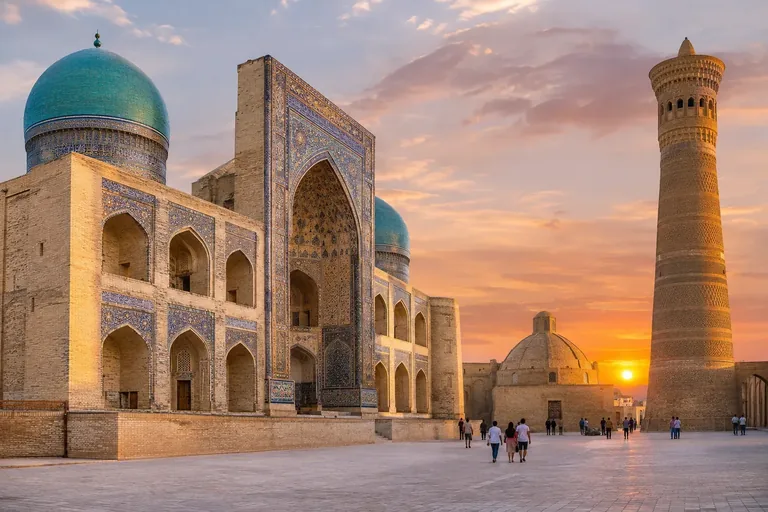
Samarkand impresses with scale; Bukhara draws you in with atmosphere. Its historic centre — a UNESCO World Heritage site — is a living town of lanes, domed bazaars, pools and more than a thousand years of buildings, from the 10th-century Samanid Mausoleum to the palaces of the last emir. Almost everything in the old town is within walking distance, so two days let you see it properly and add the shrines and palace on the outskirts. This plan spends the first day in the old core and the second on the older and outer layers of the city.
Before you start
- Getting here: the Afrosiyob train from Samarkand takes about 1.5 hours; from Tashkent, about 4 hours. Bukhara also has an airport with flights from Tashkent.
- Where to stay: a guesthouse or boutique hotel near Lyabi-Hauz puts the whole old town on your doorstep.
- Tickets: most monuments sell separate tickets on site. Carry som in cash; card acceptance at small ticket desks is not guaranteed.
- Heat: Bukhara is one of the hottest cities in the country. In summer, walk in the morning and after 16:00 and spend midday in museums or a teahouse.
- Dress: the Kalon Mosque courtyard and the Bahouddin Naqshband complex are religious sites — cover shoulders and knees; women should carry a headscarf.
Day 1: the old town core
Lyabi-Hauz and its madrasahs
Begin at Lyabi-Hauz, the pool laid out in 1620 and still the social heart of the old town. In the early morning, before the cafés fill, you can see the ensemble clearly. On its east side, the Nadir Divan-Begi Madrasah surprises with its portal: a radiant sun with a human face and two mythical birds, a rare figurative motif in Islamic architecture. To the north stands the 16th-century Kukeldash Madrasah, one of the largest in Bukhara.
Magoki Attori and the trading domes
A few steps west, the Magoki Attori Mosque sits well below today's street level — a vivid reminder of how much city has accumulated over the centuries. Its 12th-century façade with carved brick and terracotta is one of the oldest in Bukhara. From here a chain of 16th-century domed bazaars leads north. Toqi Sarrofon was once the money-changers' dome; Toqi Telpak Furushon, the hat-sellers' dome, now sells skullcaps, books and carpets; and Toqi Zargaron, the jewellers' dome, is the largest. These domes are still working bazaars — browse slowly, ask prices and bargain politely.
Two madrasahs and Poi Kalon
Just beyond Toqi Zargaron, two madrasahs face each other. The Ulugbek Madrasah of 1417 is the oldest of the three built by Timur's astronomer grandson; the Abdulaziz Khan Madrasah of 1652 shows how decoration grew richer two centuries later. A short walk brings you to Poi Kalon, the "foot of the great one", Bukhara's iconic square. The Kalyan Minaret, built in 1127, is so solidly made that Genghis Khan is said to have spared it when he destroyed the city. Facing each other across the square are the vast courtyard of the Kalon Mosque and the turquoise domes of the Mir-i-Arab Madrasah, still a working religious school, so visitors usually see only the entrance hall.
Afternoon: plov, the Ark and Bolo Hauz
Have a lunch of Bukhara plov, then spend the hot hours in the Ark, the fortress-residence of Bukhara's rulers for many centuries, until 1920. Behind its massive sloping walls are the throne courtyard, a mosque and several museum halls. Opposite the Ark, the Bolo Hauz Mosque, built in 1712, has a tall veranda on slender carved wooden columns that is reflected in the pool in front of it. Return to Poi Kalon for sunset, when the minaret and domes glow amber, and finish with dinner at a teahouse in the old town.
Day 2: older layers and the outskirts
Morning: Samanids, Job's spring and the bazaar
Start in the park west of the old town at the Ismail Samani Mausoleum, built in the early 10th century for the Samanid dynasty. It is a small cube, but its brick is laid in such intricate patterns that the walls seem woven, and the effect changes with the angle of the sun. Nearby, the Chashma Ayub Mausoleum stands over a spring that legend links to the Prophet Job; its unusual conical dome is a Khorezmian touch, and inside is a small museum about water in the desert city. Then walk on to the city's farmers' market — the green bazaar — for fruit, dried apricots, bread and spices. From there a short taxi ride takes you to Chor Minor, a gatehouse of 1807 with four turquoise-capped towers, hidden among residential lanes.
Afternoon: the emir's palace and the Naqshbandi shrine
After lunch, take a taxi north to Sitorai Mohi Khosa, the summer palace of the last emirs of Bukhara, built at the turn of the 20th century. Its halls mix Bukharan carved plaster with mirrors, European furniture and Russian stoves, and the gardens are pleasant in the late afternoon. Continue to the Bahouddin Naqshband memorial complex, the shrine of the 14th-century founder of the Naqshbandi Sufi order, which remains one of the most important pilgrimage sites in Central Asia. Behave as a guest among pilgrims: dress modestly, speak quietly and ask before taking pictures. Return for a last evening around Lyabi-Hauz.
If you have more time
- Chor-Bakr, a quiet necropolis of the Juybari sheikhs west of the city, is a good alternative to the Naqshbandi shrine on a busy Friday.
- A ceramics workshop in Gijduvan, the home of a distinctive brown-and-green pottery school, about an hour away.
- A desert jeep safari to the Jeyran ecocentre, where rare gazelles and kulans are bred and reintroduced.
Practical tips
- Lyabi-Hauz is lively until late, but the lanes around it are quiet — a torch on your phone helps on unlit streets.
- Prices in the trading domes are negotiable; compare a few stalls before buying suzani or carpets, and ask for an export receipt for older pieces.
- Taxi rides to the outskirts are inexpensive with Yandex Go; for a half day, a car with driver can be arranged through your guesthouse.
行程规划
拉比豪兹广场
Day 1. The 1620 pool shaded by mulberry trees is the heart of the old town — quiet in the morning, lively in the evening.
- 步行 1 分钟
纳迪尔·迪万别吉经学院
Look at the portal's sun and mythical birds — a rare motif in Bukhara's architecture.
- 步行 1 分钟
库克尔达什经学院
The 16th-century madrasah on the north side of Lyabi-Hauz, one of the largest in Bukhara.
- 步行 3 分钟
马戈基·阿托里清真寺
The mosque sits well below today's street level — its 12th-century patterned façade shows how many centuries of city lie underfoot.
- 步行 2 分钟
钱庄圆顶市场
The first of the trading domes — the money-changers' dome. Craft stalls fill the space under the domes.
- 步行 2 分钟
帽商圆顶市场
The hat-sellers' dome: skullcaps, books and carpets. Bargaining is normal.
- 步行 3 分钟
珠宝商圆顶市场
The jewellers' dome — the largest trading dome; jewellery and silverwork.
- 步行 1 分钟
兀鲁伯经学院
Built in 1417, the oldest of Ulugbek's madrasahs. Opposite stands the 17th-century Abdulaziz Khan Madrasah.
- 步行 4 分钟
波依卡扬建筑群
The Kalyan Minaret (1127), Kalon Mosque and the still-active Mir-i-Arab Madrasah share one square. Cover shoulders and knees for the mosque courtyard.
- 步行 19 分钟
Bukhara Plov Centre 手抓饭中心
Bukhara plov for lunch. Plov is usually cooked for lunch and may sell out later in the day.
- 步行 24 分钟
雅克城堡
The citadel of the emirs of Bukhara, with museums, the throne courtyard and a mosque. The museum halls are a good refuge in the hottest hours.
- 步行 3 分钟
博洛豪兹清真寺
The 1712 mosque opposite the Ark: its tall wooden-columned veranda is reflected in the pool.
- 步行 15 分钟
拉比豪兹茶馆
Catch sunset on the Poi Kalon square, then walk to dinner at an old-town teahouse.
- 步行 23 分钟
伊斯梅尔·萨曼尼陵墓
Day 2. The early-10th-century mausoleum with patterned brickwork is one of the oldest masterpieces of Islamic architecture in Central Asia.
- 步行 3 分钟
约伯泉陵墓
A mausoleum with a conical dome over a spring linked to the Prophet Job (Ayub); inside is a museum of water.
- 步行
绿色巴扎
The city's farmers' market: fruit, dried fruit, bread and spices. Bring cash.
- 步行 15 分钟
乔尔米诺尔四塔楼
The four-towered gatehouse of 1807, tucked among residential lanes; a short taxi ride.
- 出租车
星月宫夏宫
After lunch take a taxi to the last emir's summer palace north of the city, a blend of Eastern and European styles.
- 出租车
巴哈丁·纳克什班迪陵园
The shrine of the founder of the Naqshbandi Sufi order; women should cover their hair and everyone cover shoulders and knees. Busy on Fridays.
- 出租车
拉比豪兹广场
Return to town and end the day with an evening stroll and dinner around Lyabi-Hauz.
路线地图
本攻略涉及的景点
- 阿卜杜勒阿齐兹汗经学院1652 年建成,装饰繁复到未及完工——彩绘穹顶与钟乳拱是布哈拉晚期建筑的巅峰。
- 雅克城堡布哈拉埃米尔的王城要塞——高耸的夯土城墙内保留着觐见庭院、清真寺与马厩,是俯瞰老城的最佳起点。
- 巴哈丁·纳克什班迪陵园纳克什班迪苏菲教团创始人的安息地,是中亚重要的朝圣中心,也是理解布哈拉精神传统的关键一站。
- 博洛豪兹清真寺雅克城堡对面的埃米尔御用清真寺,二十根彩绘木柱倒映在门前水池中,因此被称为「四十柱」。
- Bukhara Plov Centre 手抓饭中心中午现做现卖的手抓饭,卖完为止——想吃正宗布哈拉抓饭就得赶早。
- 约伯泉陵墓以先知约伯传说命名的圣泉建筑,锥形塔顶造型独特,内部设有布哈拉水利史展览。
- 乔尔巴克尔陵园老城西郊的「亡者之城」——庭院、清真寺与家族墓地组成的安静建筑群。
- 乔尔米诺尔四塔楼藏在老城居民区里的四塔小楼,每座塔顶装饰各不相同,是布哈拉最上镜的小型建筑。
- 绿色巴扎以时令蔬果为主的社区市场,规模不大,适合顺路感受本地生活节奏。
- 伊斯梅尔·萨曼尼陵墓10 世纪的立方体砖砌陵墓,中亚现存最古老的伊斯兰建筑之一,砖块本身构成了全部装饰。
- 卡扬清真寺中亚规模最大的清真寺之一,庭院四周环绕两百多个砖穹顶回廊,可同时容纳上万人礼拜。
- 卡扬宣礼塔建于 1127 年的砖砌宣礼塔,高 46 米,十四道砖饰带无一重复——成吉思汗也未曾下令拆毁。
- 库克尔达什经学院拉比豪兹北侧的 16 世纪经学院,一百六十间学舍使它成为中亚规模最大的经学院之一。
- 拉比豪兹广场老城中心的古老蓄水池广场,四周桑树成荫、茶馆环绕,是布哈拉最放松的落脚点。
- 马戈基·阿托里清真寺半埋在地下的 12 世纪清真寺,遗址下叠压着更早的祆教神庙和香料市场。
- 米里阿拉伯经学院与卡扬清真寺隔广场相望的 16 世纪经学院,两座绿松石色穹顶格外醒目,至今仍在授课。
- 纳迪尔·迪万别吉经学院立面上绘有衔鹿的凤凰与人面太阳——布哈拉最不寻常的一处伊斯兰建筑装饰。
- 拉比豪兹茶馆水池边的老茶馆,绿茶配干果,桑树浓荫下最适合消磨午后。
- 波依卡扬建筑群布哈拉的心脏地带:卡扬宣礼塔、卡扬清真寺与米里阿拉伯经学院围合出的广场,是全城最具代表性的一组建筑。
- 星月宫夏宫末代埃米尔的城郊夏宫,中亚工艺与欧洲家具在同一座建筑里并存,园内还有孔雀与后妃庭院。
- 钱庄圆顶市场三座圆顶市场中最小的一座,历史上是丝路商人兑换货币的地方。
- 帽商圆顶市场五条街道交汇处的圆顶集市,历史上专卖帽子,如今是书籍、铜器和纪念品的集散地。
- 珠宝商圆顶市场三座丝路圆顶市场中最大的一座,穹顶下至今仍在打制金银首饰。
- 兀鲁伯经学院1417 年由天文学家兀鲁伯兴建,是中亚现存最古老的经学院之一,门楣上刻着「求知是每位穆斯林的义务」。