

The classic Silk Road in 7 days: Tashkent, Samarkand, Bukhara and Khiva
A one-week route through Uzbekistan's four great cities, with realistic transport between them: the Afrosiyob train to Samarkand and Bukhara, the crossing of the Kyzylkum to Khiva and a flight back from Urgench.
信息最近更新于 17.11.2026。
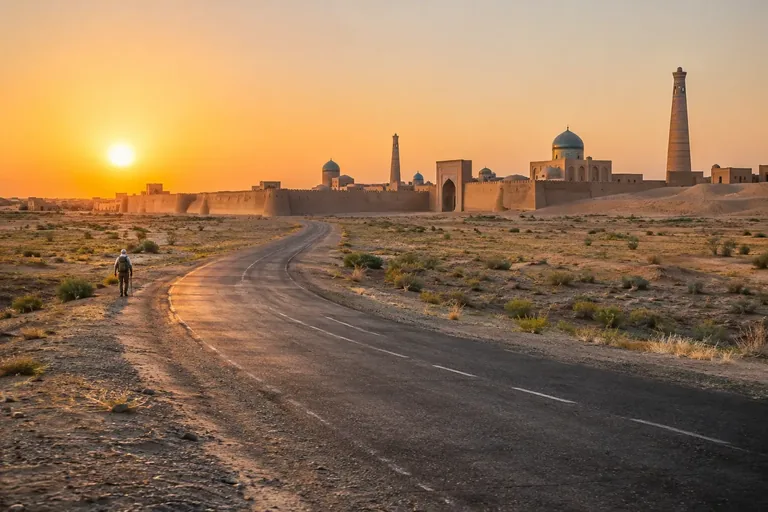
Tashkent, Samarkand, Bukhara and Khiva form the classic Silk Road circuit, and with Uzbekistan's fast trains it fits comfortably into one week. This plan gives each city the time it needs, keeps travel days short where possible and ends with a domestic flight, so you never have to retrace your steps. It works best from April to early June and from September to October; in midsummer, shift the walking to mornings and evenings.
The route at a glance
- Day 1: Tashkent — Old City, Chorsu Bazaar, metro, modern centre.
- Day 2: Afrosiyob train to Samarkand (about 2–2.5 hours) — the Registan and Gur-e-Amir.
- Day 3: Samarkand — Shah-i-Zinda, Bibi-Khanym, Siab Bazaar, Ulugbek Observatory; evening train to Bukhara (about 1.5 hours).
- Day 4: Bukhara — Lyabi-Hauz, trading domes, Poi Kalon, the Ark.
- Day 5: Bukhara — Samanid Mausoleum, Chor Minor, the emir's summer palace.
- Day 6: Across the Kyzylkum to Khiva (about 6–7 hours by train or car); sunset from the walls.
- Day 7: Khiva — Itchan Kala; transfer to Urgench and fly back to Tashkent.
Booking the transport
The backbone of the route is the train. Buy Afrosiyob tickets for Tashkent–Samarkand and Samarkand–Bukhara on the official Uzbekistan Railways site or app as soon as sales open (usually about 45 days ahead); in spring and autumn these trains sell out. For Bukhara–Khiva there are conventional trains taking roughly 6–7 hours, and since May 2026 the new high-speed Jaloliddin Manguberdi service also stops in Bukhara on its way from Tashkent to Khiva — at launch it ran three times a week, so check whether its days fit your plan. Alternatively, a private car crosses the desert in a similar time, with stops along the Amu Darya. Book the Urgench–Tashkent flight in advance too; Urgench airport is about 30–40 minutes from Khiva by taxi.
Day 1: Tashkent
Start in the Old City at the Hazrati Imam complex, where the Muyi Muborak library displays the Uthman Quran, one of the oldest surviving copies. Continue to Chorsu Bazaar under its great blue dome and eat Tashkent plov for lunch — it is cooked at midday and sells out by afternoon. In the afternoon ride the metro, whose themed stations are among the most beautiful in the former Soviet Union; Kosmonavtlar station is part of the UNESCO-listed Tashkent modernist ensemble. End at Amir Timur Square and get an early night.
Day 2: to Samarkand
Take a morning Afrosiyob and arrive before lunch. Leave your bags and walk to the Registan, three madrasahs built between 1417 and 1660 around one square. Explore the courtyards and the gilded mosque of Tilla-Kori. Towards evening visit Gur-e-Amir, where Amir Timur and his descendants are buried, then return to see the Registan illuminated.
Day 3: Samarkand, then Bukhara
Go early to Shah-i-Zinda, the street of tiled mausoleums, before the groups arrive. Walk on to the colossal Bibi-Khanym Mosque and Siab Bazaar next door, where you can buy Samarkand bread for the journey. After lunch, take a taxi to the Ulugbek Observatory, then catch an evening Afrosiyob to Bukhara — about an hour and a half.
Day 4: Bukhara's old town
Start at Lyabi-Hauz, the 1620 pool framed by madrasahs, and walk north through the 16th-century trading domes, still full of craft stalls. At Poi Kalon, the Kalyan Minaret of 1127 rises between the Kalon Mosque and the Mir-i-Arab Madrasah. Spend the hot afternoon in the Ark, residence of Bukhara's rulers until 1920, and come back to Poi Kalon for sunset.
Day 5: the older and outer Bukhara
Visit the Ismail Samani Mausoleum, a 10th-century masterpiece of patterned brick, and the nearby Chashma Ayub, then take a taxi to Chor Minor. In the afternoon drive north to Sitorai Mohi Khosa, the summer palace of the last emirs, or to the Bahouddin Naqshband shrine. Pack for an early start.
Day 6: across the Kyzylkum to Khiva
This is the long day. By train or car the journey takes about 6–7 hours through the Kyzylkum desert; by road you will see the broad Amu Darya along the way. Bring water and snacks. Arrive in Khiva in the afternoon, check in inside or near the walls of Itchan Kala and climb the walls or the Kunya Ark bastion for sunset.
Day 7: Khiva and the flight home
Buy the combined ticket at the West Gate and spend the morning in Itchan Kala: the Kunya Ark, Kalta Minor, the Islam Khoja minaret, the forest of columns in the Juma Mosque and the Tash Hauli palace. After a Khorezmian lunch — try shivit oshi — transfer to Urgench for an evening flight to Tashkent. If the high-speed train runs on your day, it is a scenic alternative: at launch it left Khiva in the morning and reached Tashkent in the afternoon.
Adapting the route
- Short on time? Fly Tashkent–Urgench on day 1, see Khiva, then travel east by train and finish in Tashkent.
- One extra day? Add Shahrisabz from Samarkand or a night in a yurt camp near Ayaz-Kala from Khiva.
- Prefer a guided trip? An organised eight-day version of this route includes hotels, train tickets, guides and the return flight.
Budget notes
The biggest fixed costs are transport and monument tickets. For foreign adults, budget approximately 100,000 som for the Registan and 250,000 som for the Itchan Kala combined ticket, plus separate tickets in Bukhara. Fares change: check current train and flight prices when booking. Carry cash for bazaars, small museums and taxis.
行程规划
Hazrati Imam Complex
Day 1, Tashkent. The Old City complex that keeps the Uthman Quran. Cover shoulders and knees.
- 步行 17 分钟
Chorsu Bazaar
The blue-domed bazaar; Tashkent plov for lunch nearby.
- 公共交通
Tashkent Metro
Kosmonavtlar and Alisher Navoi stations; a ride costs 3,000 som.
- 步行 19 分钟
Amir Timur Square
The illuminated centre in the evening. Turn in early for tomorrow's morning train.
- 公共交通
Registan Square
Day 2, Samarkand. A morning Afrosiyob takes about 2–2.5 hours; drop your bags and head to the Registan.
- 步行 12 分钟
Gur-e-Amir Mausoleum
Timur's mausoleum at dusk; then return to the illuminated Registan.
- 步行 30 分钟
Shah-i-Zinda Necropolis
Day 3, Samarkand. Fewer crowds in the morning; it is a shrine, so dress modestly.
- 步行 9 分钟
Bibi-Khanym Mosque
Timur's gigantic congregational mosque.
- 步行 2 分钟
Siab Bazaar
Buy Samarkand bread and dried fruit for the road.
- 出租车
Ulugbek Observatory
The observatory after lunch; in the evening the Afrosiyob to Bukhara (about 1.5 hours).
- 出租车
拉比豪兹广场
Day 4, Bukhara. Lyabi-Hauz and its madrasahs, then north through the trading domes.
- 步行 8 分钟
波依卡扬建筑群
The Kalyan Minaret of 1127, the Kalon Mosque and the Mir-i-Arab Madrasah.
- 步行 5 分钟
雅克城堡
The emirs' citadel; return to Poi Kalon for sunset.
- 步行 11 分钟
伊斯梅尔·萨曼尼陵墓
Day 5, Bukhara. The early-10th-century mausoleum, the oldest layer of the city.
- 出租车
星月宫夏宫
The last emir's summer palace north of the city — go by taxi. Prepare in the evening for tomorrow's long journey.
Itchan Kala
Day 6, to Khiva. About 6–7 hours by train or car across the Kyzylkum. In the evening enter by the West Gate and watch sunset from the walls.
- 步行 2 分钟
Kunya Ark
Day 7, Khiva. The Kunya Ark and Kalta Minor on the combined ticket.
- 步行 4 分钟
Islam Khoja Minaret and Madrasah
Khiva's tallest minaret; the climb is paid separately.
- 步行 1 分钟
Khiva Juma Mosque
The mosque of more than two hundred carved columns.
- 步行 2 分钟
Tash Hauli Palace
Tash Hauli Palace. After lunch, transfer to Urgench airport (about 30–40 minutes) for an evening flight to Tashkent.
路线地图
本攻略涉及的景点
- 雅克城堡布哈拉埃米尔的王城要塞——高耸的夯土城墙内保留着觐见庭院、清真寺与马厩,是俯瞰老城的最佳起点。
- Bibi-Khanym MosqueOne of the largest congregational mosques of its time, built by Amir Timur after his Indian campaign.
- Gur-e-Amir MausoleumThe mausoleum of Amir Timur and members of the Timurid dynasty, crowned by a ribbed turquoise dome.
- 伊斯梅尔·萨曼尼陵墓10 世纪的立方体砖砌陵墓,中亚现存最古老的伊斯兰建筑之一,砖块本身构成了全部装饰。
- Itchan KalaKhiva's walled inner city, an open-air museum and Uzbekistan's first UNESCO World Heritage Site (1990).
- Islam Khoja Minaret and MadrasahKhiva's tallest minaret and its small madrasah, the last major ensemble built in the early 20th century.
- Khiva Juma MosqueA unique domeless Friday mosque whose roof rests on more than two hundred carved wooden columns.
- Kunya ArkThe citadel of the Khivan khans with a tiled throne hall, summer mosque and the Ak Sheikh Bobo bastion.
- Tash Hauli PalaceAllakuli Khan's palace and harem, famous for its blue-tiled iwans and carved wooden columns.
- 拉比豪兹广场老城中心的古老蓄水池广场,四周桑树成荫、茶馆环绕,是布哈拉最放松的落脚点。
- 波依卡扬建筑群布哈拉的心脏地带:卡扬宣礼塔、卡扬清真寺与米里阿拉伯经学院围合出的广场,是全城最具代表性的一组建筑。
- Registan SquareSamarkand's main square, framed by three monumental madrasahs: Ulugbek, Sher-Dor and Tilla-Kori.
- Shah-i-Zinda NecropolisAn avenue of mausoleums covered in fine majolica at the foot of Afrasiyab hill.
- Siab BazaarSamarkand's best-known farmers' market next to Bibi-Khanym: bread, dried fruit, halva and spices.
- 星月宫夏宫末代埃米尔的城郊夏宫,中亚工艺与欧洲家具在同一座建筑里并存,园内还有孔雀与后妃庭院。
- Amir Timur SquareA leafy central square with the equestrian statue of Amir Timur, the Tashkent Chimes and views of Hotel Uzb...
- Chorsu BazaarTashkent's most famous market: spices, dried fruit, bread and handicrafts under a huge blue dome.
- Hazrati Imam ComplexTashkent's spiritual centre: 16th-century madrasahs, the Kaffal Shashi mausoleum and the Muyi Muborak libra...
- Tashkent MetroCentral Asia's first metro, opened in 1977: every station is a work of art in marble, carved plaster and mo...
- Ulugbek ObservatoryRemains of the 15th-century observatory built by Mirzo Ulugbek, with a museum about the astronomer.