

Uzbekistan for first-timers: visas, money, trains and everyday rules
Everything you need before a first trip to Uzbekistan: visa-free entry and e-visas, registration, cash and cards, SIM cards, Afrosiyob trains, flights, taxis, seasons and etiquette.
信息最近更新于 17.11.2026。
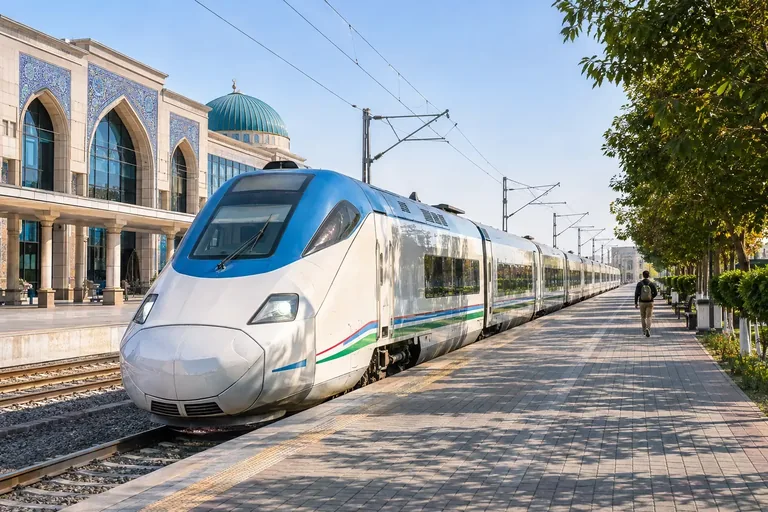
Uzbekistan has become one of the easiest countries in Central Asia to travel in independently: most visitors no longer need a visa, fast trains link the main Silk Road cities, and ride-hailing apps work in the big cities. A few local rules still surprise first-timers, though — registration, cash, train tickets that sell out. This guide collects them in one place. Rules change, so before you fly check the official sources mentioned below and treat any figure here as approximate.
Visa and entry
Citizens of roughly ninety countries — including the EU member states, the United Kingdom, Japan and South Korea — can visit Uzbekistan for tourism without a visa for up to 30 days. Since 1 January 2026 the same 30-day visa-free regime also applies to citizens of the United States. The 30 days are counted from the date of entry, and you must leave before they run out; overstaying, even by a day, can lead to a fine or deportation. Citizens of several CIS countries have separate, often longer, arrangements.
If your country is not on the visa-free list, check whether it is eligible for an electronic visa on the official portal e-visa.gov.uz. A single-entry tourist e-visa normally allows a stay of up to 30 days, costs approximately US$20 and is usually issued within a few working days. Use only the official portal — look-alike sites charge extra for the same form.
- Your passport should be valid for at least three months after arrival; some airlines prefer six, so the safer rule is six.
- Make sure your passport is stamped on entry — the stamp is checked when you leave.
- Cash above the equivalent of US$10,000 must be declared, and you cannot take out more foreign currency than you brought in.
- Some common medicines (for example, those containing codeine) are restricted. Carry prescriptions in your name and check the current list before travelling. Drones need a permit obtained in advance.
Registration: the rule most visitors forget
Foreigners must be registered at their place of stay within three days of arrival, and weekends count towards those three days. In practice this is simple: hotels and licensed guesthouses register you automatically when you check in and hand your passport to reception. If you stay with friends or in a private flat, the host must register you, usually through the online Emehmon system. If you move to another city and stay there longer than three days, you are registered again by your new accommodation.
Keep the registration slips or confirmations your hotels give you until you leave the country. Border officers rarely ask for them, but you should be able to account for where you stayed. Campers and people sleeping in tents must register themselves online within three days.
Money: som, cash and cards
The currency is the Uzbek som (UZS). Prices have many zeros — a lunch can cost 80,000–150,000 som — so it helps to check the current exchange rate before you arrive and keep a converter on your phone.
- Cards: Visa and Mastercard are accepted in most mid-range and upmarket hotels, larger restaurants, supermarkets and many museums in Tashkent, Samarkand and Bukhara. Acceptance is improving every year, but foreign cards still occasionally fail on local websites.
- Cash: bazaars, teahouses, small cafés, family guesthouses, street taxis and most places outside the big cities work in cash only. Always carry some som.
- ATMs: found at banks, malls, airports and big hotels; they dispense som and usually accept foreign cards, often with a fee. Rural ATMs can be empty, so withdraw in the cities.
- Exchange: change US dollars or euros only at banks and official exchange offices (there are some at the airport and in hotels). Bring clean, undamaged notes. Street money-changers are illegal and best avoided.
Local payment apps and many delivery services require an Uzbek bank card, so as a visitor you will mostly pay with cash or your own card.
SIM card or eSIM
Mobile internet is cheap and 4G covers the cities and main roads. You can buy a local SIM from operators such as Ucell, Beeline, Mobiuz or Uzmobile at their offices or at desks in the arrivals area of Tashkent airport (airport prices are often higher). A passport is required, and activation can take some time. Note that phones used with a local SIM for more than 30 days must be registered in the national IMEI system. The simplest alternative is a data-only travel eSIM bought before departure: it gives you internet from the moment you land but no local number for SMS codes. Coverage in the desert and high mountains is patchy, so download offline maps.
Trains: Afrosiyob, Sharq and the new line to Khiva
Trains are the best way to move between the Silk Road cities.
- Afrosiyob — the high-speed train: Tashkent–Samarkand takes about 2–2.5 hours and Samarkand–Bukhara about 1.5 hours.
- Sharq and other fast day trains are slower (roughly 3.5–4 hours from Tashkent to Samarkand) but cheaper, and useful when the Afrosiyob is sold out.
- To Khiva: conventional and overnight trains run to Urgench and Khiva; from Bukhara the trip takes about 6–7 hours. In May 2026 a new high-speed service, the Jaloliddin Manguberdi, began running Tashkent–Samarkand–Bukhara–Urgench–Khiva, taking about 7.5 hours end to end; at launch it ran three times a week, so check the current schedule.
Buy tickets on the official Uzbekistan Railways site eticket.railway.uz or its official app. Sales usually open about 45 days ahead, and in spring and autumn Afrosiyob seats can sell out weeks in advance — book as soon as your dates are fixed. Enter your name exactly as in your passport and bring the passport to the station: it is checked at the entrance and on board. Arrive 30–40 minutes early because there is security screening, and check which Tashkent station is printed on your ticket. Fares rose in early 2026; budget approximately 300,000 som for an economy Afrosiyob seat from Tashkent to Samarkand and confirm the price when booking.
Domestic flights
Tashkent has domestic flights to Urgench (the airport for Khiva, about 30–40 minutes away by taxi), Nukus, Bukhara, Samarkand, Termez and the Fergana Valley. Most flights take 1–2 hours. A popular plan is to travel west by train and fly back to Tashkent from Urgench, saving a long day on the rails. Book early in high season and allow extra time for airport security.
Taxis and city transport
Yandex Go is the main ride-hailing app in Tashkent and other large cities, including Samarkand and Bukhara; it shows the price before you ride and accepts cash or a linked card. If you take a street taxi, agree on the fare before getting in. For intercity trips there are shared taxis from designated stands and private transfers your hotel can arrange. In Tashkent the metro is fast and beautiful: a ride costs 3,000 som, and photography in stations is now allowed.
When to go
- Spring (April–May) and autumn (September–October) are ideal: warm days, cool evenings and gardens or harvest markets at their best. These are also the busiest months, so book trains and hotels early.
- Summer (June–August) is very hot — Bukhara, Khiva and the desert regularly exceed 40°C. Sightsee early and late, rest at midday, or escape to the mountains around Tashkent.
- Winter (November–March) is cold and sometimes snowy but quiet, with lower hotel prices. Skiing at Amirsoy and Chimgan usually runs from December to March.
Navruz, the spring new year on 21 March, brings festivals and special dishes such as sumalak.
Dress and etiquette at religious sites
Uzbekistan is a secular, relaxed country, but many monuments are still active mosques and shrines. Cover shoulders and knees; women should carry a headscarf for active mosques and pilgrimage sites such as the Hazrati Imam complex in Tashkent, Shah-i-Zinda in Samarkand or the Pahlavon Mahmud Mausoleum in Khiva. Take off your shoes where carpets are laid, keep your voice low, avoid visiting during Friday midday prayers and ask before photographing people, especially women and worshippers.
Tipping and bargaining
Many restaurants add a service charge of about 10–15% to the bill — check before tipping. Where there is no charge, rounding up or leaving 5–10% is appreciated. Guides and drivers are usually tipped at the end of a tour. In bazaars and craft shops bargaining is normal and expected; in shops with price tags it is not.
Other useful details
- Time zone: UTC+5 nationwide.
- Electricity: 220 V, European plugs (types C and F).
- Drink bottled or filtered water rather than tap water.
- Uzbekistan is generally safe for travellers; the usual care with pockets in crowded bazaars applies.
- Hospitality is a big part of local culture — accepting a bowl of tea or a piece of bread when offered is the polite thing to do.
本攻略涉及的景点
- Amirsoy Mountain ResortA modern year-round resort in the Chimgan mountains: gondolas, about 15 km of slopes, chalets and a spa.
- Pahlavon Mahmud MausoleumShrine of Khiva's patron saint — the 14th-century poet, wrestler and furrier Pahlavon Mahmud.
- Shah-i-Zinda NecropolisAn avenue of mausoleums covered in fine majolica at the foot of Afrasiyab hill.
- Hazrati Imam ComplexTashkent's spiritual centre: 16th-century madrasahs, the Kaffal Shashi mausoleum and the Muyi Muborak libra...
- Tashkent MetroCentral Asia's first metro, opened in 1977: every station is a work of art in marble, carved plaster and mo...