

Bukhara in 2 days: trading domes, Poi Kalon and the emir's palace
Two days in the most atmospheric of Uzbekistan's old cities: Lyabi-Hauz and the trading domes, the Kalyan Minaret at sunset, the Ark, the Samanid Mausoleum and the shrines and palaces beyond the old town.
Information last updated on 17.11.2026.
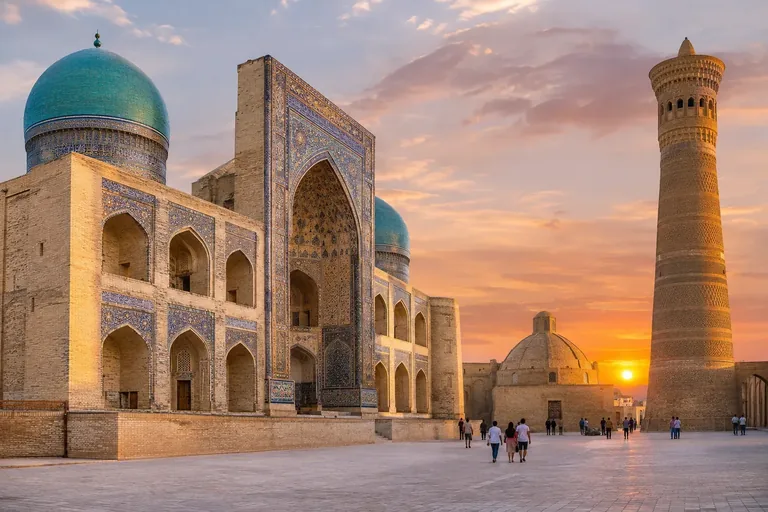
Samarkand impresses with scale; Bukhara draws you in with atmosphere. Its historic centre — a UNESCO World Heritage site — is a living town of lanes, domed bazaars, pools and more than a thousand years of buildings, from the 10th-century Samanid Mausoleum to the palaces of the last emir. Almost everything in the old town is within walking distance, so two days let you see it properly and add the shrines and palace on the outskirts. This plan spends the first day in the old core and the second on the older and outer layers of the city.
Before you start
- Getting here: the Afrosiyob train from Samarkand takes about 1.5 hours; from Tashkent, about 4 hours. Bukhara also has an airport with flights from Tashkent.
- Where to stay: a guesthouse or boutique hotel near Lyabi-Hauz puts the whole old town on your doorstep.
- Tickets: most monuments sell separate tickets on site. Carry som in cash; card acceptance at small ticket desks is not guaranteed.
- Heat: Bukhara is one of the hottest cities in the country. In summer, walk in the morning and after 16:00 and spend midday in museums or a teahouse.
- Dress: the Kalon Mosque courtyard and the Bahouddin Naqshband complex are religious sites — cover shoulders and knees; women should carry a headscarf.
Day 1: the old town core
Lyabi-Hauz and its madrasahs
Begin at Lyabi-Hauz, the pool laid out in 1620 and still the social heart of the old town. In the early morning, before the cafés fill, you can see the ensemble clearly. On its east side, the Nadir Divan-Begi Madrasah surprises with its portal: a radiant sun with a human face and two mythical birds, a rare figurative motif in Islamic architecture. To the north stands the 16th-century Kukeldash Madrasah, one of the largest in Bukhara.
Magoki Attori and the trading domes
A few steps west, the Magoki Attori Mosque sits well below today's street level — a vivid reminder of how much city has accumulated over the centuries. Its 12th-century façade with carved brick and terracotta is one of the oldest in Bukhara. From here a chain of 16th-century domed bazaars leads north. Toqi Sarrofon was once the money-changers' dome; Toqi Telpak Furushon, the hat-sellers' dome, now sells skullcaps, books and carpets; and Toqi Zargaron, the jewellers' dome, is the largest. These domes are still working bazaars — browse slowly, ask prices and bargain politely.
Two madrasahs and Poi Kalon
Just beyond Toqi Zargaron, two madrasahs face each other. The Ulugbek Madrasah of 1417 is the oldest of the three built by Timur's astronomer grandson; the Abdulaziz Khan Madrasah of 1652 shows how decoration grew richer two centuries later. A short walk brings you to Poi Kalon, the "foot of the great one", Bukhara's iconic square. The Kalyan Minaret, built in 1127, is so solidly made that Genghis Khan is said to have spared it when he destroyed the city. Facing each other across the square are the vast courtyard of the Kalon Mosque and the turquoise domes of the Mir-i-Arab Madrasah, still a working religious school, so visitors usually see only the entrance hall.
Afternoon: plov, the Ark and Bolo Hauz
Have a lunch of Bukhara plov, then spend the hot hours in the Ark, the fortress-residence of Bukhara's rulers for many centuries, until 1920. Behind its massive sloping walls are the throne courtyard, a mosque and several museum halls. Opposite the Ark, the Bolo Hauz Mosque, built in 1712, has a tall veranda on slender carved wooden columns that is reflected in the pool in front of it. Return to Poi Kalon for sunset, when the minaret and domes glow amber, and finish with dinner at a teahouse in the old town.
Day 2: older layers and the outskirts
Morning: Samanids, Job's spring and the bazaar
Start in the park west of the old town at the Ismail Samani Mausoleum, built in the early 10th century for the Samanid dynasty. It is a small cube, but its brick is laid in such intricate patterns that the walls seem woven, and the effect changes with the angle of the sun. Nearby, the Chashma Ayub Mausoleum stands over a spring that legend links to the Prophet Job; its unusual conical dome is a Khorezmian touch, and inside is a small museum about water in the desert city. Then walk on to the city's farmers' market — the green bazaar — for fruit, dried apricots, bread and spices. From there a short taxi ride takes you to Chor Minor, a gatehouse of 1807 with four turquoise-capped towers, hidden among residential lanes.
Afternoon: the emir's palace and the Naqshbandi shrine
After lunch, take a taxi north to Sitorai Mohi Khosa, the summer palace of the last emirs of Bukhara, built at the turn of the 20th century. Its halls mix Bukharan carved plaster with mirrors, European furniture and Russian stoves, and the gardens are pleasant in the late afternoon. Continue to the Bahouddin Naqshband memorial complex, the shrine of the 14th-century founder of the Naqshbandi Sufi order, which remains one of the most important pilgrimage sites in Central Asia. Behave as a guest among pilgrims: dress modestly, speak quietly and ask before taking pictures. Return for a last evening around Lyabi-Hauz.
If you have more time
- Chor-Bakr, a quiet necropolis of the Juybari sheikhs west of the city, is a good alternative to the Naqshbandi shrine on a busy Friday.
- A ceramics workshop in Gijduvan, the home of a distinctive brown-and-green pottery school, about an hour away.
- A desert jeep safari to the Jeyran ecocentre, where rare gazelles and kulans are bred and reintroduced.
Practical tips
- Lyabi-Hauz is lively until late, but the lanes around it are quiet — a torch on your phone helps on unlit streets.
- Prices in the trading domes are negotiable; compare a few stalls before buying suzani or carpets, and ask for an export receipt for older pieces.
- Taxi rides to the outskirts are inexpensive with Yandex Go; for a half day, a car with driver can be arranged through your guesthouse.
Itinerary
Lyabi-Hauz Square
Day 1. The 1620 pool shaded by mulberry trees is the heart of the old town — quiet in the morning, lively in the evening.
- 1 min walk
Nadir Divan-Begi Madrasah
Look at the portal's sun and mythical birds — a rare motif in Bukhara's architecture.
- 1 min walk
Kukeldash Madrasah
The 16th-century madrasah on the north side of Lyabi-Hauz, one of the largest in Bukhara.
- 3 min walk
Magoki-Attori Mosque
The mosque sits well below today's street level — its 12th-century patterned façade shows how many centuries of city lie underfoot.
- 2 min walk
Toqi Sarrofon
The first of the trading domes — the money-changers' dome. Craft stalls fill the space under the domes.
- 2 min walk
Toqi Telpak Furushon
The hat-sellers' dome: skullcaps, books and carpets. Bargaining is normal.
- 3 min walk
Toqi Zargaron
The jewellers' dome — the largest trading dome; jewellery and silverwork.
- 1 min walk
Ulugh Beg Madrasah
Built in 1417, the oldest of Ulugbek's madrasahs. Opposite stands the 17th-century Abdulaziz Khan Madrasah.
- 4 min walk
Poi Kalon Complex
The Kalyan Minaret (1127), Kalon Mosque and the still-active Mir-i-Arab Madrasah share one square. Cover shoulders and knees for the mosque courtyard.
- 19 min walk
Bukhara Plov Centre
Bukhara plov for lunch. Plov is usually cooked for lunch and may sell out later in the day.
- 24 min walk
Ark Fortress
The citadel of the emirs of Bukhara, with museums, the throne courtyard and a mosque. The museum halls are a good refuge in the hottest hours.
- 3 min walk
Bolo-Hauz Mosque
The 1712 mosque opposite the Ark: its tall wooden-columned veranda is reflected in the pool.
- 15 min walk
Lyabi-Hauz Teahouse
Catch sunset on the Poi Kalon square, then walk to dinner at an old-town teahouse.
- 23 min walk
Ismail Samani Mausoleum
Day 2. The early-10th-century mausoleum with patterned brickwork is one of the oldest masterpieces of Islamic architecture in Central Asia.
- 3 min walk
Chashma-Ayub Mausoleum
A mausoleum with a conical dome over a spring linked to the Prophet Job (Ayub); inside is a museum of water.
- On foot
Green Bazaar
The city's farmers' market: fruit, dried fruit, bread and spices. Bring cash.
- 15 min walk
Chor Minor
The four-towered gatehouse of 1807, tucked among residential lanes; a short taxi ride.
- Taxi
Sitorai Mokhi-Khosa Palace
After lunch take a taxi to the last emir's summer palace north of the city, a blend of Eastern and European styles.
- Taxi
Bahauddin Naqshband Memorial Complex
The shrine of the founder of the Naqshbandi Sufi order; women should cover their hair and everyone cover shoulders and knees. Busy on Fridays.
- Taxi
Lyabi-Hauz Square
Return to town and end the day with an evening stroll and dinner around Lyabi-Hauz.
Route map
Places in this guide
- Abdulaziz Khan MadrasahThe most lavishly decorated madrasah of 17th-century Bukhara.
- Ark FortressA 2,500-year-old citadel that housed the emirs of Bukhara.
- Bahauddin Naqshband Memorial ComplexA major pilgrimage site associated with the founder of the Naqshbandi order.
- Bolo-Hauz MosqueThe emir's mosque, its carved columns mirrored in the pond.
- Bukhara Plov CentreLunch only: real Bukhara plov from giant kazan cauldrons.
- Chashma-Ayub MausoleumA multi-domed shrine built over the legendary Spring of Job.
- Chor Bakr Memorial ComplexA sixteenth-century pilgrimage and architectural complex in Sumitan.
- Chor MinorA one-of-a-kind gatehouse with four blue-domed towers (1807).
- Green BazaarA greens-and-vegetables market on the new-town side.
- Ismail Samani MausoleumThe oldest intact brick mausoleum in Central Asia (9th–10th c.).
- Kalon MosqueA 16th-century Friday mosque with room for ten thousand worshippers.
- Kalyan MinaretThe 46-metre tower of 1127 that became the enduring symbol of Bukhara.
- Kukeldash MadrasahBukhara's largest madrasah, with 160 student cells.
- Lyabi-Hauz SquareThe living heart of the old town, set around a pond dug in 1620.
- Magoki-Attori MosqueOne of Bukhara's oldest mosques, sunk below street level.
- Mir Arab MadrasahA working Islamic seminary in continuous use since 1536.
- Nadir Divan-Begi MadrasahFamed for the mythical Humo birds soaring across its portal.
- Lyabi-Hauz TeahouseGreen tea and sweets on daybeds at the water's edge.
- Poi Kalon ComplexKalon Minaret and Mosque — the symbol of the city.
- Sitorai Mokhi-Khosa PalaceThe last emir's summer palace, where East meets European style.
- Toqi SarrofonThe money-changers' dome — a medieval currency exchange.
- Toqi Telpak FurushonThe cap-sellers' dome at a meeting of five old streets.
- Toqi ZargaronThe jewellers' trading dome, in business since the 16th century.
- Ulugh Beg MadrasahThe oldest surviving madrasah in Central Asia, built in 1417.